

Why Weeds Love Drought-Stressed Lawns
Most homeowners assume drought damages grass and weeds equally.
Unfortunately, that’s not how it works.
In fact, one of the biggest misconceptions we encounter across Rock Hill, Fort Mill, Clover, Lake Wylie, Indian Land, Kings Mountain, and surrounding communities is that a drought automatically kills weeds. In reality, drought conditions often create the perfect environment for weeds to take over.
That’s especially true this year.
Local meteorologist Brad Panovich recently shared updated drought monitor maps showing gradual improvement across the Carolinas. While that’s encouraging news, much of our region remains under significant drought stress, and many lawns are still dealing with the lingering effects of months of dry conditions as we prepare for peak summer heat.
At Hippo Turf Care, we’ve spent the past several months evaluating lawns affected by drought stress. One trend continues to stand out: lawns weakened by drought are becoming far more vulnerable to weed invasion.
Here’s why.
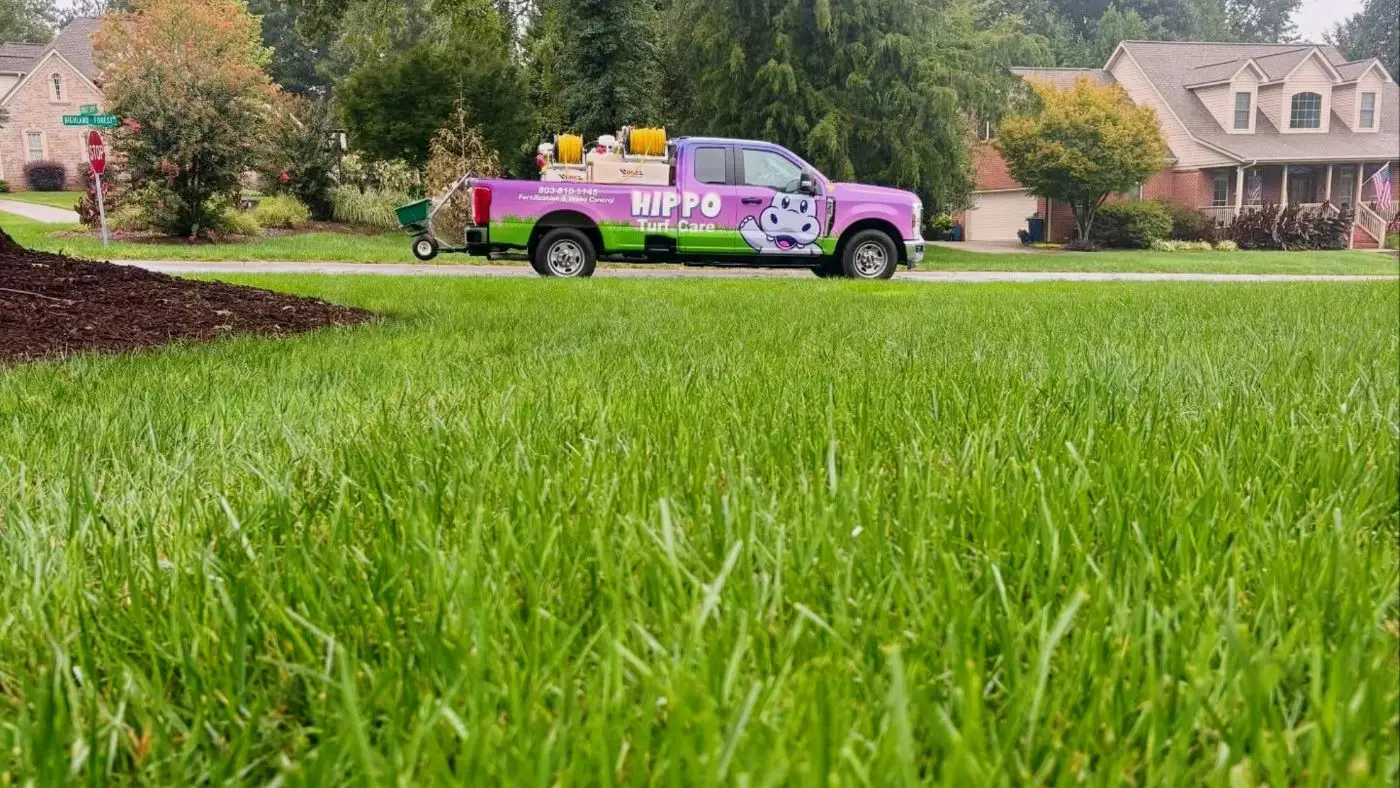
A Healthy Lawn Is Your Best Weed Control
Before we talk about weeds, it’s important to understand how a healthy lawn naturally protects itself.
Thick turfgrass acts like a living barrier. When grass is dense and actively growing, sunlight struggles to reach the soil surface. Weed seeds have difficulty germinating, and new weeds often can’t compete for space, moisture, or nutrients.
Think of a healthy lawn as a crowded parking lot.
When every space is occupied, there’s nowhere for weeds to move in.
But drought changes that equation quickly.
Drought Creates Openings Weeds Love
During extended dry periods, turfgrass shifts into survival mode.
Instead of producing new growth, the plant focuses on preserving energy and protecting its root system. Growth slows. Turf density decreases. Some areas thin significantly. In severe cases, portions of the lawn may go dormant or die altogether.
Once that happens, sunlight begins reaching the soil surface.
Those open areas become opportunities.
Nature doesn’t like empty space, and weeds are incredibly good at finding it.
Many weed species are opportunistic plants designed specifically to colonize disturbed or stressed environments. While your lawn struggles to recover from drought conditions, weeds often move in aggressively.
That’s why homeowners frequently notice more weeds after a drought than during it.
The drought didn’t necessarily create the weeds.
It weakened the lawn’s natural defenses.
Why Some Weeds Actually Thrive During Stressful Conditions
One of the things we explain regularly to customers is that many common weeds are built differently than turfgrass.
Certain weed species produce deep root systems capable of reaching moisture well below the rooting depth of stressed turf.
Others complete their life cycle rapidly, allowing them to germinate, grow, and spread before turfgrass has a chance to recover.
Some even thrive in compacted, nutrient-deficient soils where desirable turf struggles.
As turf managers, we often see drought-stressed lawns become vulnerable to:
The specific weeds vary from property to property, but the underlying issue remains the same: weakened turf creates opportunity.

The Rain Returns… and the Weeds Explode
Here’s where many homeowners get caught off guard.
After months of dry weather, we finally receive beneficial rainfall.
People expect their lawn to bounce back immediately.
Instead, they suddenly notice weeds everywhere.
Why?
Because weed seeds have been waiting.
Many weed seeds can remain dormant in the soil for extended periods. Once moisture becomes available, germination can happen quickly.
Meanwhile, drought-stressed turfgrass is still recovering.
The result is a race.
If weeds establish themselves before the turf fully rebounds, they can gain a significant advantage.
This is one reason we often see weed outbreaks shortly after weather patterns begin improving.
Why Weed Pressure Is Different Across York County
Not every lawn experiences drought stress the same way.
Several factors influence how vulnerable a property becomes:
Soil Type
Clay-heavy soils common throughout portions of York County can become extremely hard during prolonged dry periods.
Compacted soils limit root development and reduce water infiltration, increasing turf stress.
Grass Type
Bermuda, Zoysia, and Fescue all respond differently to drought conditions.
Warm-season grasses like Bermuda and Zoysia generally tolerate drought better than Fescue, but even they can thin under extended stress.
Existing Turf Health
Lawns receiving consistent fertilization and weed control programs typically withstand drought more effectively than neglected lawns.
Healthy root systems make a tremendous difference when rainfall becomes scarce.
Irrigation Practices
Improper watering can sometimes create additional stress rather than alleviate it.
Shallow, frequent watering often encourages weaker root systems compared to deep, infrequent watering practices.
What We Are Seeing in Local Lawns Right Now
As a local turf management company, we’re currently seeing several common patterns throughout the region.
Many lawns still appear greener than they did a few months ago thanks to recent rainfall.
However, beneath the surface, many turf systems remain stressed.
Root development has been impacted.
Turf density has been reduced.
And weed pressure is beginning to increase.
In other words, some lawns may look better than they actually are.
This is often the stage where proactive management makes the biggest difference.
Waiting until weeds become fully established usually means a more difficult and expensive recovery process.
How to Help a Drought-Stressed Lawn Recover
If your lawn has experienced drought stress this year, focus on strengthening the turf rather than simply reacting to visible weeds.
Key recovery practices include:
Maintain Proper Fertility
Healthy turf requires adequate nutrition to rebuild density and recover from environmental stress.
Strategic fertilization encourages stronger growth and improved competitiveness against weeds.
Continue Weed Control
Early intervention is critical.
Allowing weeds to mature and spread creates additional challenges later in the season.
Improve Soil Conditions
Aeration, proper watering practices, and ongoing soil management help create an environment where turf can recover more effectively.
Be Patient
Recovery doesn’t happen overnight.
Even after drought conditions improve, turfgrass often requires weeks or months to fully regain density and vigor.
What We’re Seeing in Local Lawns Right Now
The latest drought monitor updates are certainly encouraging, and we’re hopeful that continued rainfall will bring additional improvement across the Carolinas.
But from what we’re seeing in lawns throughout York County and surrounding areas, the drought’s impact isn’t over just because the maps are improving.
Many lawns are still dealing with reduced turf density, weakened root systems, and increasing weed pressure. That’s exactly why this period matters. The lawns that recover best are typically the ones that receive consistent care before weeds become established and begin competing with desirable turf.
Recovery is possible, but it rarely happens by accident.
Ready to Join the Hippo Turf Care Family?
If you’re looking for professional turf care services to help your lawn survive drought, peak summer heat, and beyond, we’d love the opportunity to earn your trust.